Goals change games, but understanding why they happen is what truly changes performance.
A final score tells you the outcome. Expected Goals tells you the story underneath it. Inside Playlab, xG transforms every shot into measurable insight, giving coaches and players a clearer view of chance quality, decision-making, and attacking efficiency.
From Outcome to Understanding
For decades, performance analysis revolved around simple metrics: goals, shots, shots on target. While useful, these numbers lack context. A 25-meter strike and a six-yard tap-in both count as one shot. If both go in, they count as one goal.
But they are not equal chances.
Expected Goals reframes scoring as a probability problem. Instead of asking, Did it go in? we ask, How likely was it to go in?
That shift moves analysis from reactive to predictive.
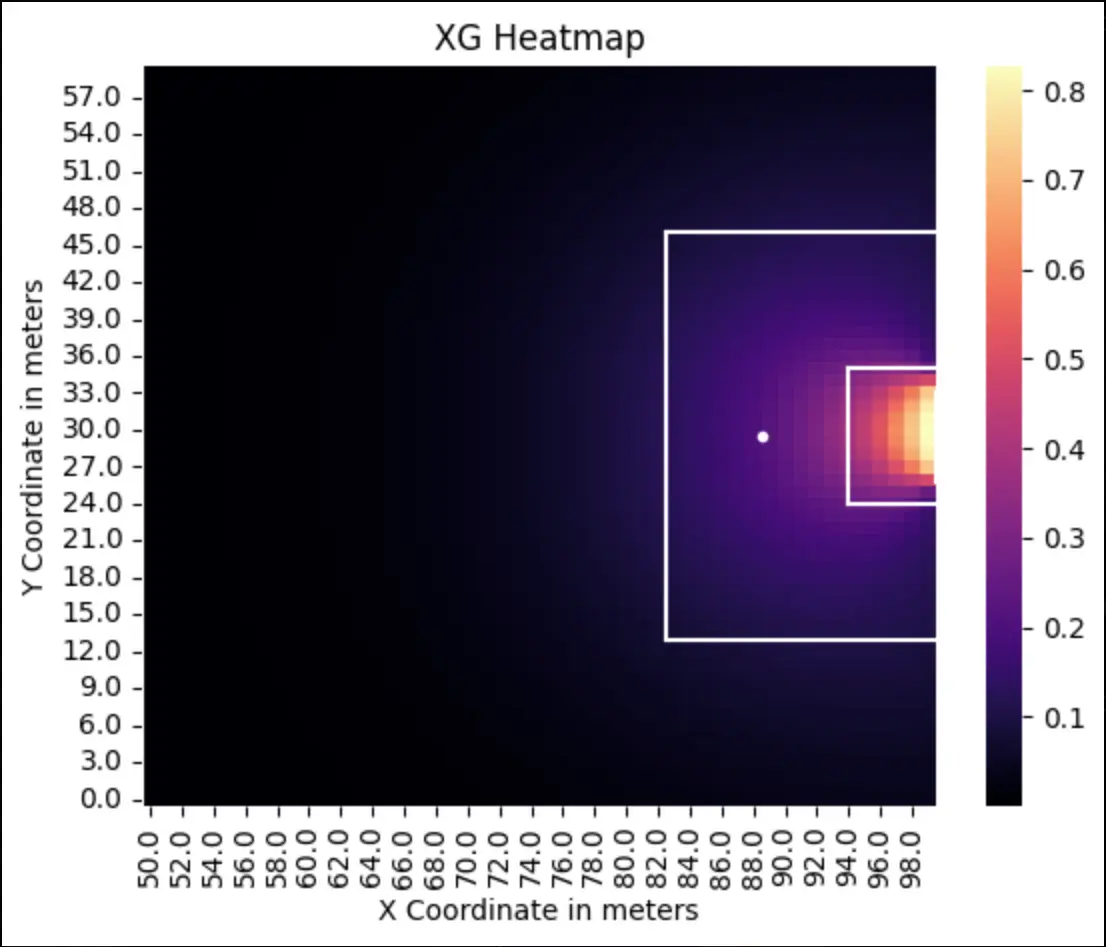 This visual model illustrates how the probability of scoring changes based on a player’s distance and angle to goal.
How the Playlab xG Model Works
Every shot in Playlab is treated as a data point within a simple binary outcome: goal or no goal. Using a large historical dataset of thousands of attempts, the model learns which contextual factors consistently influence scoring probability. It evaluates elements such as distance and angle to goal, body part used, assist type, and game situation, along with additional variables that define the moment. Each of these features contributes to the true quality of the opportunity. Most importantly, Playlab goes beyond surface-level metrics to understand how these factors work together, not just individually.
Capturing the Interactions That Matter
Performance is layered. Every moment is connected.
Distance and angle combine to reshape the difficulty of an attempt. A header from 10 meters carries a different probability profile than a volley from the same distance. A cutback from the end line, where the defense is often stretched and moving toward its own goal, produces a far higher expected value than a speculative long-range strike.
The real strength of the model lies in its ability to capture these interactions. It learns how combinations of factors influence scoring likelihood, not just the factors themselves.
The output is a calibrated probability between 0 and 1 for every shot. A 0.45 xG chance represents a significantly higher-quality opportunity than a 0.05 attempt, even if both result in the same outcome on the day.
This allows teams to measure performance with far greater precision.
Turning Insight Into Competitive Advantage
Expected Goals changes the questions you ask. Instead of focusing on shot volume, you evaluate chance quality. Are you creating high-value opportunities or settling for low-percentage efforts? Are you conceding dangerous chances despite a comfortable scoreline? By translating every attempt into a probability, xG helps coaches distinguish between tactical structure and execution. High xG with low goals may point to finishing issues, while low xG overall may signal problems in chance creation. It also allows performances to be compared objectively across matches and seasons, regardless of the final score.
PlayLab turns raw event data into actionable insight. Coaches can identify structural strengths and weaknesses. Analysts can track sustainable trends over time. Recruitment decisions become more informed by assessing chance quality rather than relying solely on goals scored or conceded. Players gain clarity on shot selection, understanding which profiles consistently produce higher-value outcomes.
The result is a shift from instinct-driven evaluation to evidence-based preparation.
Preparing for What Comes Next
Performance is not just about the result. It is about understanding what should have happened and using that knowledge to improve what happens next.
By clearly measuring chance quality, Playlab helps teams look beyond the scoreboard and understand their true level of performance.
Because long-term success is not built on isolated goals. It's built on consistently creating better chances than your opponent.
Discover how Playlab gives your team clarity beyond the scoreline.